
Gian Kharag
The Sword of Enlightenment That Destroys Ignorance
Payment NOT Processed:
The introductory chapter entitled … “ਮਾਸੁ ਮਾਸੁ ਕਰਿ ਮੂਰਖੁ ਝਗੜੇ;; i.e. MEAT-RENOUNCING-RITUALIST IDIOT FIGHTS SHOUTING ‘MEAT, MEAT”; … provides an introductory insight into the background of a squabble that seems to be picking up speed to become a very damaging issue for the Sikhs. The dispute being; should the Sikhs completely renounce the consumption of meat as a religious practice, or not? … Furthermore, does Sikh Philosophy have a clear-cut stand on this issue? If so, then what is it? … Also, how does one evaluate a particular argument made to support a particular stand as being correct? And how any such arguments can/should be tested for their correctness/authenticity on the touchstone of Gurbani?
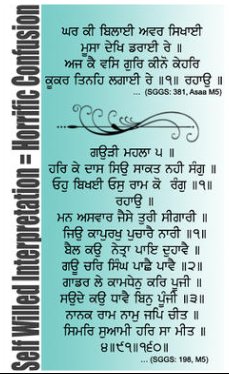
(2) … The chapter entitled … “THE CORE PRINCIPLE (That should never be forgotten while interpreting any scripture)” … sets up the fundamental parameters in response to the last question in the previous chapter. It tackles the following question: …To seek sincere guidance from any book of knowledge (including Sri Guru Granth Sahib, the Revered Scripture of the Sikhs),… is it advisable for anyone to twist and turn the underlying meaning of its words of wisdom to justify one’s own self-willed interpretation? If not, then what and how should it be interpreted? Especially if one wishes to avoid the pitfall of … Self Willed Interpretation = Horrific Confusion.
(3) … The chapter titled … “WRITERS WHO PROVE THEIR MANMATEE OBJECTIVE AS GURMAT” … provides the reader with some interesting examples from the pens of very renowned authors, wherein the said authors come to horrific conclusions as a result of their forced, blatant self-willed interpretations.
(4) … Next, the write-up entitled … “BLASPHEMY OF GURBANI: With an Intentional hiding of ‘TRUTH’???”; … empowers the reader to ask the question: … To justify one’s own misconceived notion, or some self-willed interpretation, should one, as a writer, even go to the extent of intentionally hiding some uncomfortable Truths from the Reader? Furthermore, wouldn’t such an action amount to Blasphemy of Gurbani?… For a full understanding of this issue, this chapter provides some very interesting examples of such behaviour.
(5) … The chapter titled … “SELECTED GURBANI-SHABAD” … reveals a very interesting observation regarding the tricks that the advocates of meat renunciation use in their selection of Gurbani Quotes (to spread their self-willed notion that meat eating is a cardinal DON’T for the Sikhs) .
(6) … Next, a collection of … “GURU COMMANDS ON CLEAR-CUT DO’s & DON’TS”; … further distinguishes between, in an unambiguous way, the ‘CLEAR CUT’ Do’s & Don’ts of Gurbani, and the ‘FUZZY’ Do’s & Don’ts advocated by the promoters of meat renunciation to justify their perceptions/interpretations. Furthermore, this chapter provides greater additional insights by directly citing a number of example quotes from Gurbani .
(7) … Here, the subject titled … “EGO, FALSE PRIDE, and UNION with GOD” … explores the questions: … as a priority, what tops Guru Sahib’s list of renunciations? Is it the act of renunciation of meat, as advocated by some amongst us? Or, is it some thing else? Further, in case one ends up choosing the wrong kind of renunciations as a top priority of one’s life, then how is the human mind impacted by such a choice?
(8) … Next, the sub-heading titled … “HUMBLENESS” … explores the question: What is the magnitude and the extent of humbleness that Guru Sahib advocates? Do we, as Sikhs, understand the magnitude of that extent?
(9) … “AN ILLOGICAL QUESTION” … (Asserted in general by the Meat-Renouncers) … “If Satguru Jees have not prohibited eating meat in any clear words, then where have they given the command allowing such a practice?” … Is answered herein.
(10) … Next, regarding the question of … “USE OF THE WORD ‘MEAT’ IN GURBANI” …, this chapter explores the answer to the question: … Has the use of the Punjabi word ‘Maas (meat)’ been strictly avoided in the sacred Sikh scripture, Sri Guru Granth Sahib? Or has it been used freely? Further, if used, then does it convey a positive connotation towards the use of meat, or a negative one?
(11) … As indicated by the Title … “GURMAT TAT NIRNAIY (Bhai Randhir Singh Jee)” … this chapter revisits Bhai Randhir Singh Jee’s book entitled “Gurmat Tut Nirnaiy”, that Bhai Sahib (a very staunch and strict advocate of meat renunciation) has written to advocate his notion that the practice of meat renunciation is an absolute must for the real practice of the Sikh faith. … Unfortunately, the fact of the matter is, that such assertions by some (including Bhai Randhir Singh Jee) have created a deep divide in Sikh circles; namely, a very small but vocal minority, that has fallen for such assertions, has renounced even eating eggs (considering it to be the ultimate altruistic act); whereas, on the other hand, there is a very large, but silent majority that marches on, ignoring such notions as being nothing but a web of Ritualistic Brahaminical Hogwash/Trap.
Therefore, in order to analyze the issue in the light of Gurbani (the Guru’s Word), this chapter takes a critical look at Bhai Sahib Jee’s writing, assertions, and his attitude towards those Sikhs, who, choose to disagree with him, etc.
(12) … Next, … “THE EPISODE OF KURUKUSHETAR SOLAR ECLIPSE” … is the chapter in connection with a historic episode of Guru Nanak Sahib’s visit to Kurukushetar (a prominent center of Hindu learning) on the celebratory occasion of a Solar Eclipse. The basic Hindu belief propagated to the masses through this occasion is that, … during an eclipse, neither any fire should be lit to cook any food, nor any cooked food should be consumed during an eclipse in order to avoid defilement.
However, in contrast to the advocacy of the above belief, it is said that during this aforementioned visit of Guru Nanak Sahib, a Sikh of the Guru brought deer meat as an offering for the Guru’s Langar (free kitchen). And, as per Guru Sahib’s directions, that deer meat was cooked in the open for Guru’s Langar to feed the hungry. And this was the action against which, the Temple Priests reacted with anger and even ended up fighting with the Guru Sahib.
Regarding the description of this incident, every Sikh scholar (whether an advocate of strict renunciation of meat, or not) agrees to the facts of the episode. However, when it comes to the episode’s moment of serving of the meat in the Guru’s Langar, the hell of disagreements breaks loose (for the obvious reason that it is at complete odds with the present-day (anti-Guru?) practice of vegetarianism in the Sikh Langar.)
To say the least, such a problematic dilemma makes the analysis of the type of assertions offered by some to explain away this episode, very interesting.
(13) … Moving forward, the chapter entitled … “EPISODE OF GURU’S HARDWAR VISIT” … compares and contrasts the Hardwar visit to the Kurukushetar episode. In the Hardwar episode, Guru Sahib threw water of the river Ganga in the westward direction to explode the prominent belief that peoples’ ancestors somehow lived in the sun and hence, would be cooled off when their descendants threw water towards the rising sun in the East. This chapter explores the stark differences and similarities between the nature of Guru Nanak Sahib’s very explosive and confrontational visit to Kurukushetar to confront the superstition of meat renunciation, and his very non-confrontational, but unorthodox approach in the Hardwar episode.
(14) … Herein, the chapter entitled … “KILLING FOR MEAT & BHAI RANDHIR SINGH JEE’S VIEW” … is a brief commentary on the interjection of the concept of ‘Sootak’ (the underlying belief in the superstition of Brahaminical Defilement caused by births & deaths) into the debate of ‘Killing for Meat”. This is an interjection that has been done by Bhai Randhir Singh Jee (a staunch advocate of renunciation of meat) through his write up titled ‘ਜੀਵ ਹਤਿਆ ਦੇ ਅਸੂਲ ਉਤੇ ਵਿਚਾਰ ਅਤੇ ‘ਜੇ ਕਰਿ ਸੂਤਕ ਮੰਨੀਐ’ ਵਾਲੇ ਸਲੋਕ ਦਾ ਅਸਲ ਸਿਧਾਂਤ’ ਵਾਲੇ ਸਲੋਕ ਦਾ ਅਸਲ ਸਿਧਾਂਤ’ Deliberation upon; the principle of Killing of Living Creatures, and the Real Foundational Principle of the Slok; ‘if one accepts the concept of Sootak ਸੂਤਕ.’
(15) … This chapter captioned … “BRAHAMINICAL-DEFILEMENT of SOOTAK & GURMAT”; … provides a detailed analysis of the word Sootak in the light of Gurbani, (the Guru’s Word) enshrined in the sacred Sikh Scripture, Sri Guru Granth Sahib.
Thus, such a Gurbani based analysis in this chapter, not only explodes the Brahaminical superstitions and myths that very intricately surround the word ‘Sootak’, but also answers questions like; … What does the word Sootak really mean? … What is the Brahamnical concept of Sootak? … Where does the Brahminical concept of Sootak come from? … What is the difference between the Brahaminical, and the Gurbani based concepts of Sootak? … What is it that Guru Sahib considers as Sootak? … Should one be afraid of the Brahaminical Sootak (said to be caused be the process of birth & death)? … What is the real Sootak that one should be carful about? ... Does it have anything to do with the issue of eating or renouncing the practice of eating meat? etc.
(16) … Titled as … “REJECTION OF GURMAT PRINCIPLES WITH GURU-SHABADS THAT REJECT THE SUPERSTITION OF BRAHAMINICAL-DEFILEMENT?”; … This chapter in a very methodical way explains & lays bare the intricacies of the kind of Brahminical pitfalls, that even the learned Sikh scholars like Bhai Randhir Singh Ji, have not been able to avoid when interpreting Gurbani to prove, some of their single minded write ups. That is why the title of this chapter is in a question format that questions and expresses a surprise, stating “ REJECTION OF GURMAT PRINCIPLES? … WITH GURU-SHABADS? … THAT REJECTS THE SUPERSTITION OF BRAHAMINICAL-DEFILEMENT?
This chapter also further shows how easy it is to fall into such intricate pitfalls if one is not always mindful of their dangers. The most prominent ignored danger sign that leads one to fall into such pitfalls being the selective/partial selection of some ‘one liner’ statements from Gurbani, that, in their context mean something entirely different versus the meaning being conveyed through their out-of–context misuse.
(17) … Next, the chapter captioned … “THE WORD ‘KUTHAA’ (IN THE EYES OF BHAI RANDHIR SINGH JEE & OTHER ANTI-MEAT SCHOLARS)“; … explores the word ‘Kuthaa’ that seem to carry a different meaning for different sets of Sikhs depending upon the type of group with which they seem to associate.
As per the ‘Sikh Code of Conduct, the Sikh Rehat Maryada’, out of it’s four cardinal prohibitions, one of the prohibitions is; Don’t eat ‘Kuthaa’; wherein in a footnote, the word ‘Kuthaa’ is explained in the following words; …. ‘(ਕੁਠਾ ਤੋਂ ਭਾਵ ਉਹ ਮਾਸ ਹੈ, ਜੋ ਮੁਸਲਮਾਨੀ ਤਰੀਕੇ ਨਾਲ ਤਿਆਰ ਕੀਤਾ ਹੋਵੇ) i.e. The word ‘Kuthaa’ means that meat, which is prepared the Muslim way.
However, despite the above explanatory note that in no uncertain terms explains the meaning of the word Kuthaa as Halaal meat, the advocates of complete renunciation of meat continue insisting that the word ‘Kuthaa’ means, meat (Halaal or not), and not exclusively Halaal meat as explicitly explained by the Sikh Rehat Maryada.
This chapter, as well as the following two chapters, are in a way ‘a war of words’, through which the meat renunciators (with Bhai Randhir Singh Jee’s writings leading the charge) are trying to prove their point of view as the correct interpretation of the word ‘Kuthaa’, while the non-vegetarians are insisting on the Sikh Code of Conduct interpretation.
(18) … Thus, to have a better insight into the correctness/incorrectness of the aforementioned, two, very diametrically opposing claims, the write-up entitled … “HISTORICITY OF THE WORD ‘KUTHAAA’ “; … explores the history of questions like; What is the reason for declaring Kuthaa (the Muslim Halal meat) as a cardinal Don’t for the Sikhs? … Is the reason, the way the Muslims slaughter an animal? … Or is it something else? … What are the historical developments that lead to the coining of the word ‘Kuthaa’? … What is its origin? … How in spite of ‘Kuthaa’ being Halal meat, it has turned out to be recognized as something being different from meat? … In the Indian cultural setting, what was the prime reason for this word ‘Kuthaa’ to become so hateful, that it ended up becoming one of the four Cardinal Don’ts of the Sikh faith?
(19) … Next, continuing the inquisition, the section titled … “THE WORDS ‘KUTHAA’ & GURBANI”; … explores the questions; … Does the word ‘Kuthaa’ appear in the Sikh scripture, SGGS? … If so, then where, and in what context? … Furthermore, in its context, does it carry the same meanings, which the staunch meat-renunciation Sikh scholars, like Bhai Randhir Singh Jee, Bhai J.P.Sangat Singh Jee, and Bhai Joginder Singh Jee Talwara, have projected it to carry in its out-of-context format?
(20) … Next, the section titled … “ANOTHER SCENE OF BLATENT VIOLATION OF GURBANI PRINCIPLES”; … While using some very real examples, focuses on making the readers aware of the kind of pitfalls that one can end up falling into if one does not stay mindful and focused on the discussion at hand, and the context of the Gurbani quotations that one decides to select to bolster the line of reasoning.
(21) … The chapter titled … “BHAI J.P.SANGAT SINGH JEE & PROHIBITION OF MEAT”; … explores and questions the limits of the liberties that a writer can/needs to take to keep his/her write-up as appropriate. For such a feat it raises questions like; … How far can one go to twist and turn the spirit and intent of some authoritative reference material to use it to prove one’s own misperceived notion as the righteous concept? Furthermore, should or shouldn’t one keep such twists and turns within certain limits so that the final write up is still considered to be appropriate? … Is it appropriate to pick and choose a part of some statement from the original ideas in its out-of–context format to prove some self-willed notion as correct? … Can some reference idea be turned even upside down in one’s zest to prove a point, and the process still considered appropriate; … especially if the reference material is Gurbani? … This chapter provides some interesting examples for the reader’s consideration.
(22) … Herein the section titled … “PURITY – DEFILEMENT AND GURBANI”; … explores the answer to the query: Can someone acquire good traits like being soft spoken, of high character, brave, and of having fear of God etc. by purely eating some special foods; perceived by some, to be pure and immaculate?
(23) … Next, in the write-up titled … “OMNI-PRESENCE OF THE TIMELESS”.; … The Question of interest is: Do the words, ‘Omni-presence of the Timeless’ mean; ‘unconditional’ or ‘selective’ presence of the Timeless’?
(24) … This chapter titled … “GURU-COMMANDMENTS MISUSED AGAINST THE PRACTICE OF NON-VEGETARIANISM?” … is an interesting exposure of quite a few strategies and intellectual twists, turns, and manipulations, wherein, by the use of Guru-Commandments (that have nothing to do with the practice of eating meat), many unsuspecting reader are made to believe that for a Sikh it is not righteous to eat meat.
(25) … This write up titled … “THE WORD ‘MURDAAR’ AND GURBANI” … explores the answer to the questions; … what is ‘Murdaar’ in the Gurbani context? … Is it the obvious despicable stinky meat of a rotten Carcass? Or, is it something else?
(26) … Next, the section titled … “EVEN MORE CONDEMNABLE ACTS OF CLEVERNESS?” … Explores and exposes another set of intellectual acts of cleverness and manipulation, through which out-of-context partial Gurbani quotes are (mis?) used to mislead the unsuspecting readers into believing in something that the selected Gurbani quotes never intended to convey.
(27) … “MISUSE OF BHAI GURDAS’S VAARS”; … asks the question; … Do picking and choosing statements from Bhai Gurdas Jee’s Vaar, like; … “one should not adopt entrapping and catching birds by their legs, as a hobby” (Vaar 31), … and … “what kind of ending is in store for those like you, who highhandedly kill and eat others?” (Vaar 25) etc; lead one to an un-contestable conclusion like the one, wherein, Bhai Randhir Singh Jee concludes; … “This is it. Now the dispute is over. It is proven that one’s taste for meat and alcohol is the most useless, worthless, and despicable taste of all the tastes.”
(28) … The subject matter herein titled … “A STRANGE PRINCIPLE OF BHAI J.P.SANGAT SINGH JEE”; … investigates Bhai Sahib’s claims questioning; … What does it take to become a brave and solid Sikh? … Is it renunciation of meat, as claimed by some advocates of meat renunciation (citing the example of Puraatan Sikhs, of olden times)? … Were the puraatan Sikhs (who, confronted and stopped the tyranny of the regular Muslim invasions of India from the North-West, and shook up the foundation of the most powerful Empire of their times, the Moghal Empire) pucca meat renunciants? … OR, in contrast, (talking about the olden times) was Guru Nanak Sahib, the founder of the Sikh Way of life, a meat eater, or a pucca meat renunciant? … Also, in puraatan (olden) times, was it, or was it not, a Sikh tradition to serve meat in the Sikh Langar? Etc.
(29) … “IMMORTALITY OF SOUL & GURBANI” … As per Gurbani, is the soul-conscience perishable, or not?
(30) … “VIEWS OF THE ANTI-MEAT SECT” … Provides an interesting insight into the common strategies and tricks of the Anti-Meat Sects; that the Sect leaders use to push their Anti-Meat Brahaminical agenda into the Sikh psyche.
(31) … The chapter titled “ਅਸੰਖ ਗਲਵਢ ਹਤਿਆ ਕਮਾਹਿ” … delves deeper into the subject matter of the previous chapter in order to empower the reader to go to the next depth level. … With the use of the touchstone of Gurbani, it lays bare the mechanism and vocabulary that the operators of this Brahamnical fraud use to fool the unsuspecting Sikh masses.
(32) … Herein “GURU COMMANDMENTS ABOUT HUMAN FOOD” … As per Guru Granth Sahib, what is the recommended true food for a good Human life? … Is it the so-called vegetarian food ? Non-vegetarian food? Or something else?
(33) … “INDULGENCE IN SENSUAL PLEASURES” … investigates the fundamental question; What does one acquire in this life by staying indulgent in sensual pleasures?
(34) … Next the topic titled “BODY … A ROBE FOR THE SOUL-CONSCIOUS” answers: … In a living being, what relation do the soul and body have to each other?
(35) … Next, the chapter titled “HUMAN BODY-A RARE GIFT” explains why the human body is considered as a rare gift and why it’s so special?
(36) … Regarding “ਜੀੳ ਦਇਆ ਪਰਵਾਨੁ ; i.e. KINDNESS TO LIVING CREATURES” … What constitutes the real kindness towards living creatures ?
(37) … Explaining the relationship between “GURBANI AND COMPASSION” this chapter, citing some very interesting examples, poses a very basic question (to all those writers who seek Guru’s Word’s support for the authentication of their logic); … Is it appropriate for any writer, to pick and choose, very selectively, some words or lines from Gurbani for an out-of-context misuse to bolster his/her misconceived notions?
(38) … “THUS IN SUMMATION” is basically a concluding summation.
(39) … “APPENDIX” provides the original Punjabi versions of the translated excerpts, that have been used in this book as reference materials.