
Gian Kharag
The Sword of Enlightenment That Destroys Ignorance
Payment NOT Processed:
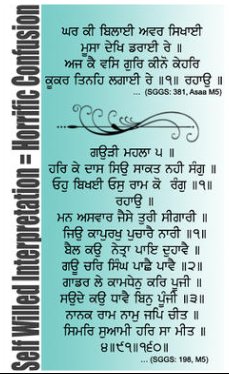
Whether we the Sikhs of the present day era (in the year 2011 CE) like to accept it or not, the fact of the matter is, that if we dare to have an honest look at our present day existence, we will find that one of our most glorious pillars of Sikh character-building, namely the ‘Khanday Dee Pahul’, is in serious jeopardy. It is that ‘Khanday Dee Pahul’ for which the Sikhs of the Guru/post-Guru era were willing to/and did offer their heads; whereas on the contrary, most of the Sikhs of the present day era do not want to touch it (even with a ten-foot pole). Therefore an honest, free and frank introspection is definitely a must to find out, what has gone so wrong? And how?
Today, besides the Sikh homeland of Punjab, Sikhs are spread all around the globe and are trying to adjust to the new realities of their latest existence in the global village (that is loaded with numerous Eastern, Western, and Internet educational influences). Thus, in the mix of this entire melee, quite a few challenges are popping up for the Sikhs from various quarters (i.e. their new neighbors, educated Sikhs, and their own children - raised in the new non-Punjabi, and non-Brahaminical environments). And, as a result, many of the Sikhs, not being able to cope up with the new surroundings and pressures, have completely yielded. They have abandoned their identity, as well as their desire to ever have ‘Khanday Dee Pahul’. Furthermore this defeatist attitude has not stayed confined to the foreign lands alone, and has found its way to the homeland as well.
On the positive side, to the good fortune of the Sikhs, the presence of Sri Guru Granth Sahib (the Sikh Divine Scripture)" in its un-altered form is still intact and can guide the Sikhs in their time of crisis (even though it has also gotten surrounded by quite a bit of anti-Gurmat Brahaminical ritualism).
Regarding the institution of ‘Khanday Dee Pahul’, two major debates surrounding this institution are causing a tug of war in the Sikh circles. These debates about the discipline of Pahul are:
(a) Inclusion of some Prayer compositions in the Sikh’s daily routine that are outside of Sri Guru Granth Sahib (some Sikhs consider this unacceptable because they see it as a violation of Guru Gobind Singh Sahib’s Order of Guru Manyo Granth).
(b) The issue of Meat questioning; whether a practicing
Sikh could eat meat or not?
It is the second issue that
is the focus of this
book, titled, ‘Sikh Dilemma; Is not eating meat a Brahminical Command for Sikhs?’
Regarding Meat,
there are three
competing advocacies at present:
(a) The Mainstream Sikh Code of Conduct,the Sikh Rehat Maryada that allows a practicing Sikh to eat meat, while prohibiting the eating of Kuthaa Meat (i.e. the Halaal meat processed the Muslim way).
(b) A very small,but very vocal minority's Bipran Kee Reet oriented practices; that under the influence of some personality cults (of Baba cultures), promote their own individual Codes of Conduct. These codes in general, advocate a very strict renunciation of meat, including eggs.
(c) The very large, but ill-informed majority's confusion; that under the scares created by the vocal minority's ‘Bipran Kee Reet’ quirks, have been made to believe, that ‘Khanday Dee Pahul’ is not within a common person's reach (except for -a small minority of strict meat renouncers). Hence it is an impossible task for the vast (mostly non-vegetarians) majority of Sikhs to undertake. As a result the confused majority end up taking the easy way out (i.e. not only staying away from a very valuable, practical, modern, scientific, broadminded and all-embracing discipline of ‘Khanday Dee Pahul’, but also abandoning their very empowering Sikh Identities as well.)
Therefore, for such a serious situation, this book strives to get guidance from the Eternal Guru of the Sikhs, Sri Guru Granth Sahib. By using the Guru's Word, Gurbani, as the TOUCHSTONE, this book explores the contending issues. Furthermore, in order to avoid the pitfalls of the commonly practiced paraphrasing and misinterpretation of the Sri Guru Granth Sahib, this book strictly adheres to the following Core Principle of scriptural interpretation: