
Gian Kharag
The Sword of Enlightenment That Destroys Ignorance
Payment NOT Processed:
That should never be forgotten
While
Interpreting any scripture
As per the philosophy of the Hermeneutics branch of ‘Social Science’; while interpreting any book or scripture, it is not only wrong but mere bull headedness to advocate, some of its out of context ‘Words’ or 'statements' chosen in isolation, as its Central Theme. For correctly interpreting any book, the meaning of each and every statement of the book should be in tune with the Philosophy of the book. Therefore, any interpretation of any statement that falls outside of the Philosophy of the book should never be considered as the correct interpretation under any circumstances.
Therefore, to guard against such a pitfall in the interpretation of Gurbani (the Guru’s Word) should always be interpreted in the spirit of Gurmat; that is the Guru’s Will. Any interpretation guided by one’s Self-Willed motives of Manmut can never be correct. Therefore, before moving forward let us very clearly understand the distinction between Guru-Willed and Self-Willed interpretations, in the light of the above principles.
The Guru-Willed Interpretations: are those interpretations, which;
DO NOT violate ANY of the principle of Gurbani.
DO NOT have even a shadow of the Principles of any opposing Philosophy like the ‘Bipran Kee Reet; i.e. The Ways of the Ritualist’ in it.
And, The Self-Willed Interpretations: are those interpretations, where;
No attention has been paid to violations of Gurbani Principles.
Through manipulations, or use of some word meanings, some ‘out of context’ statements from Gurbani have been used to prove some ‘Violation of core Principles of Gurbani’ as being the ‘correct interpretation.’ Or,
The arrangement of the statements of Gurbani has intentionally been disturbed to suit the whims of the interpreter.
Keeping the above facts is mind, Special Attention needs to be paid, while interpreting Gurbani. …..Many times Satguru Jee has provided a very deep understanding of the subject matter through the use of some metaphoric words, which on the surface may look to be contradictory to the Principles of Gurmat; but in reality they are not. For example;
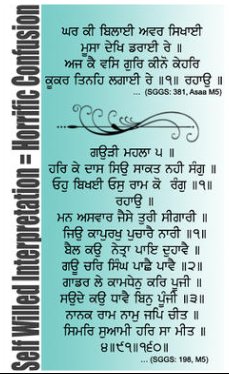
As per the mere word meanings of the following Tuk (couplet) of SGGS, it says;
ਘਰ ਕੀ ਬਿਲਾਈ ਅਵਰ ਸਿਖਾਈ ਮੂਸਾ ਦੇਖਿ ਡਰਾਈ ਰੇ || ਅਜ ਕੈ ਵਸਿ ਗੁਰਿ ਕੀਨੋ ਕੇਹਰਿ ਕੂਕਰ ਤਿਨਹਿ ਲਗਾਈ ਰੇ ||੧|| ਰਹਾਉ || (SGGS: 381, Aasaa M5)
Translated literally, it means; The house-cat has been taught otherwise, and is terrified upon seeing the mouse. …..The Guru has put the tiger under the control of the goat, and now, the dog eats grass. ||1||Pause||’
Doesn’t the literal translation of the statement sound funny and impossible? Can this statement be in tune with the Principles of Gurmat or Laws of Nature? Can it be the truth? Obviously, it doesn’t seem so.
However, once one understands as to what the words Cat, Mouse, Lion, Goat, and Grass metaphorically mean in terms of human behaviour, everything becomes crystal clear. Cat is the irresistible vice of human greed for Maya, the Mouse. Lion is the uncompromising human vice of arrogance, and Goat is the sense of humility. Dog is the insatiable human vice for delicacies, and the grass is a metaphor for a contended heart. With these metaphors is mind this is how the interpretation looks like;
(He, whom the Guru has bestowed with the gift of Nam Amrit, his) house-cat (like tendencies of irresistible greed for Maya) has been taught otherwise, and it is (now) terrified upon seeing the mouse (the Maya). … The Guru has put the tiger (of his arrogance) under the control of the goat (of humility), and now, his (insatiable) dog (inside) eats grass (contended with simplicity). ||1||Pause|| … (SGGS: 381, Aasaa, M5)
Another example: ……
(O Friend) There cannot be any union between a God’s servant and a faithless cynic. (For,) the cynic loves vices, while God’s servant is imbued with God’s love. ||1||Pause||
It (such a Union) would be like an imaginary rider on a decorated horse, or an eunuch caressing a woman. ||1|| …It would be like tying up an ox and trying to milk it, or riding a cow to chase a tiger. ||2|| …It would be like taking a sheep and worshipping it as the Elysian cow, the giver of all blessings; it would be like going out shopping without any money. ||3|| ...O Nanak, (in the company of God’s Servants), consciously meditate on the God’s Name. Meditate in remembrance on the Supreme Master, your Best Friend. ||4||91||160||
Now, here if one reads the entire Shabad by keeping its central theme expressed in its ‘Pause’ statement in mind, then one will understand very clearly about the examples that Satguru Jee has given regarding the differences between the Servants of God, and the faithless cynic. However, if one chooses to understand the remaining Shabad in isolation, by leaving the ‘Pause’ statement out, then one will not understand anything. Rather, one will be at a loss to figure out as to what is the Fifth Guru Sahib saying?
Therefore, those writers who intend to get the readers to become familiar with the real understanding of Gurbani never consider such interpretations of Gurbani as proper, from which, any of the Principles of Guru Granth Sahib Jee are violated.
However, on the other hand, there are many writers and interpreters of Gurbani, who, do not care much about the concepts of the Central Theme of Guru Granth Sahib, or keeping it intact. Therefore, in their own sweet will, they end up picking and choosing some Gurbani words or statements in isolation, with the sole objective of proving their Self-willed Manmut of pre-conceived notions as Gurmat.